Unfixed Identity
Seeing Donor-Conceived Voices Through a Queer Lens


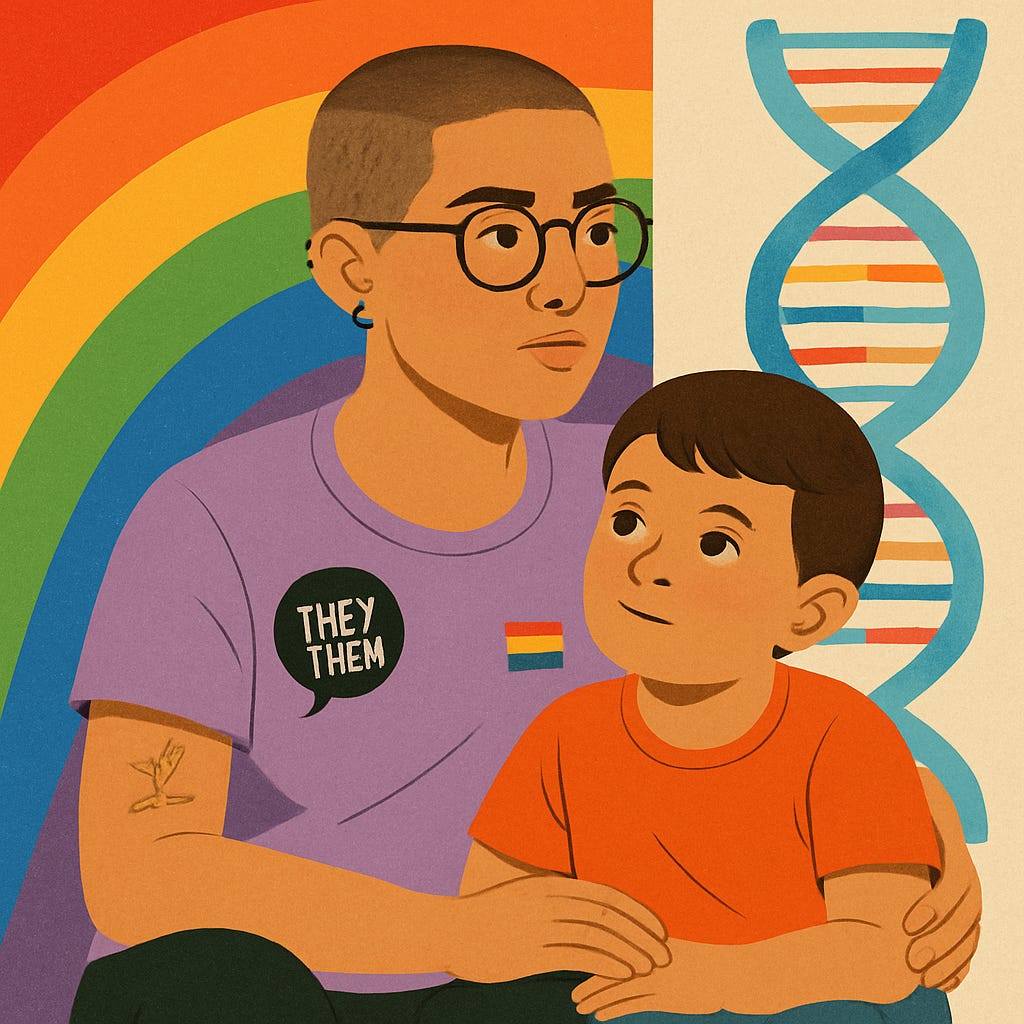
There are countless reasons I’m grateful to be queer, and recently I added another one to the list: it’s helped me understand donor-conceived voices as a recipient parent.
My identity as a nonbinary, pansexual, queer person has been anything but linear. I’ve wrestled with language, disclosure, and the constant work of reimagining (and re-communicating) who I am. I’ve come to learn from my experiences that identity is rarely fixed or easily defined, so when I began listening to donor-conceived people, parts of their stories felt instantly familiar. Although being queer and being donor-conceived come with distinct experiences and challenges, I believe that queerness offers a framework for understanding the fluid, evolving, and sometimes destabilizing experience of identity in ways that aid in understanding feelings around identity in donor conception and/or being donor-conceived.
The Language of Identity
Queer communities are no strangers to the power of language. As individuals and as a collective, we’ve reclaimed, redefined, and taken ownership of countless words: family, partner, they/them, queer to name a few. This flexibility of language invites a corresponding flexibility of thought and identity, which can be profoundly freeing. For people like me, who grew up believing certain identities were fixed (like being a “girl”) learning that there are more expansive ways to define the human experience has allowed for more experience itself.
I’ve also experienced how language can be gatekept, and used as a tool of exclusion. Like many nonbinary people who use they/them pronouns, I’ve often heard the argument that “they” and “them” are grammatically incorrect for a single person (which is categorically untrue). We’ve also been told, as a community, that we can only be defined by our assigned (typically biological) sex at birth. Trans women and men have been told that the definitions of the words “woman” and “man” exclude them. When I hear these arguments in my own life, I don’t see it as a debate about semantics; I see it as a debate about whether or not trans identities are valid. Whether we’re seen as full people with autonomy, and with the ability to know ourselves better than anyone else. Part of why I love the words queer and nonbinary is because, even as they define, they also resist definition. They tell you what I am not, but not what I am. They leave me room to exist freely.
The strict boundaries people have built around what it means to be human are fenced with the very words we use to describe ourselves. I have come to see how those fences are arbitrary, self-imposed, and protect nothing except an outdated, unkind, and rigid worldview.
That same struggle over language, the power to define and the fear of what definitions might mean (or might threaten), is something I’ve also noticed in conversations about donor conception. Donor-conceived people whose experiences or identities are diminished or reduced, even from within their own community. Donor-conceived people being told what they can and cannot be. What should and should not matter to them. What words do and do not mean.
Who can be called a parent? A sibling? Is specificity in terms like “biological father” or “donor-conceived half-brother” necessary, or can you simply say father or brother? If I call a donor-conceived half-brother a brother, does that take something away from “full” brothers? Do we need to separate parent the verb from parent the noun? Can the same word have many, similar meanings?
What’s striking to me is that in both queerness and donor conception, our initial understanding of what’s possible (or even allowed), inevitably, comes from our parents and societal norms. My parents, through no fault of their own, assumed my gender and sexuality in ways that reinforced the idea that being cisgender and straight was the default. Similar dynamics are at play here: parents who assume donor conception is unimportant, or who rely on phrases like “love makes a family”, may unintentionally reinforce ideas about family and belonging that become difficult to question later, especially if their children’s experiences or feelings diverge from that narrative.
As I wrote in my book:
“[T]he deeper I got into my learning, the more the phrase “love makes a family” started to feel like “I don’t see color” in conversations about race. You can’t acknowledge that something is real—that every person has two biological parents or that race and skin color shape our lives—and then try to erase it with something more comfortable. It doesn’t work that way if you’re trying to do right by the people most impacted.”
The narrower our definitions become, the more they suggest to people that curiosity, or even the simple act of acknowledging their otherness (their existence outside of clean, standard or assumed definitions), is unwelcome. Narrow definitions create a narrow way of living and a narrow way of seeing the world.
But language is only part of it. Once you have the words, you still have to decide when, how, and whether to use them at all.
Identity Disclosure and Assumptions
Where language defines what’s possible, disclosure defines what’s visible.
Invisible identity is another shared experience between some queer/trans people and donor-conceived people. Assumptions are inescapable with many facets of identity, but for queer/trans people (or people with queer/trans parents) whether or not to disclose these parts of our identity is actually a question of whether or not we feel safe.
To be clear: there are levels of safety, and for queer and trans people historically the stakes have been life and death. I say this to point out that while there are parallels to be drawn, there are inescapable and important differences.
Regardless, when it comes to safety in disclosure, I’ve noticed similarities between some of the stories I’ve heard from donor-conceived people and my experiences as a queer/trans person. I choose my words and topics carefully depending on my audience. I often assess whether or not to bring something up, or more accurately, if I have the capacity for follow up questions, judgement or to be met with an emotional stonewall. This calculus of safety and disclosure is familiar to me as a queer person, and surprisingly, when I try to talk about donor conception with other recipient parents–but that’s a topic for another day.
The parallels between disclosure experiences between queer and donor-conceived people are many: the question of safety, the burden of having to educate others, the revolving door of opportunities to disclose (or not), and the weight of belonging to a minority community that must constantly explain its own existence and fight for rights within systems never built with us in mind.
I’ve also heard a common fear that our parents will take our identity as a betrayal of the values that they raised us with. That we will be reminded (and reprimanded for the fact) that we are not who they wanted us to become, or wanted to believe us to be.
For donor-conceived people and queer people alike, we likely didn’t hear conversations about people like us growing up and there are constant debates about what pieces of our identity are “age appropriate” to discuss with children. Queer people know the importance of introducing nuance in identity and family structure to our children from a young age, because we know what a difference it might have made for us. I believe the same is true when thinking about a child’s donor-conceived identity. In order to minimize shame and harm (and, unfortunately, to prepare children for the burden of identity), we need to introduce these concepts with nuance and honesty from the start. We need to be the first (and consistent) safe space for our children to understand and explore who they are.
Late Discovery and Reimagining Selfhood
Whether our identities were deemed age-inappropriate, taboo, or downright unacceptable, some donor-conceived people and queer or trans people share many of the same questions when we are finally allowed to understand and explore our identities.
What happens when you assume something about yourself that isn’t true?
What does new information mean for who you were before you knew it?
How does it change the way you remember your own history (or your childhood)?
What other parts of yourself that once felt immutable might actually be fluid?
There’s also a familiar kind of discomfort:
How do I ask people who already know me one way to incorporate this new truth?
How does this information change my existing relationships?
How much do I want to (or do I have an obligation to) engage with this community now that I know I’m a part of it?
But there’s another layer here that sets donor-conceived experiences apart and is important to name.
For late-discovery donor-conceived people, there’s also the reckoning with a truth that was kept from them, and in some cases, with lies told to maintain that secrecy. While there are parallel complexities in how our parents signal openness to certain parts of our identity (or how they respond once we name those parts) late discovery or disclosure in donor conception carries an additional weight: it often involves a fracture of trust, not just a gap in understanding.
Both queerness and donor conception ask us to live with truths that may destabilize us. They ask us to live with truths that can’t be neatly reconciled or that must coexist with other, seemingly conflicting truths. They ask us to accept that knowing more might change everything, and then to be brave enough to keep asking the questions anyway.
Identity as a Process of Becoming
Integrating new truths into my identity over and over again has led me to accept that who I am will always be evolving. My identity is not set in stone. It isn’t something to strive for or arrive at. It’s a lifelong journey, and an endless process of becoming. I am always changing, and the more open I am to new truths as they emerge, the more freely I believe I’ll be able to live.
Understanding my own evolution has changed how I see the people I love, too. This knowledge makes me a better partner, because I know my wife is always becoming. It makes me a better parent, because I know my child is always becoming. It allows me to approach others with a humility that I believe is necessary for creating a better and kinder future.
Speaking of my child, the reason I have been so compelled to understand the parallels in these identities is because I want to figure out how my own experiences can inform my parenting choices and help me support him in this, and his many other intersecting identities. If my queerness taught me anything, it’s that identity doesn’t need to be proven or qualified in any way to be real. It just needs space to exist.
In the case of my son, I have come to understand that my wife and I need to be the ones to create that space when it comes to his identity as a donor-conceived person, and then step back and allow him to claim it in whatever way he’d like.
Minimizing Harm
Parents can care or not care about queer identities or biology or genetics, but they don’t get to decide whether their children will. The only real choice is whether to mirror children’s natural curiosity with openness, or to model denial and hope it causes no harm. That belief guides the way I want to raise my son.
I want to choose the language I use around my son intentionally. I want to use language that gives him the freedom to explore his many identities in whatever way feels natural to him. I want to face my insecurities and fears honestly before they can unintentionally shape our relationship. And I want to think critically about my own experiences, using them to better understand the issues faced by the community my son is part of.
If queerness taught me to hold complexity, parenting has taught me to live inside of it.
My hope is that my child grows up with language that feels like expansion and opportunity, not restriction. That he learns his story without shame, and that he knows his parents, like his identity, are always becoming, too.
Both queerness and parenting have taught me that love isn’t about simplifying what’s complex to be easily digestible; but about making space for, and more importantly finding joy in, the complexity itself.
I share more of my story as a queer, multiracial, agnostic, nonbinary, recipient parent in my memoir: My Son’s Siblings, A Queer Parent’s Memoir on the Joys, Grief and Ethics of Donor Conception.
Additional Writing:
The Half Sibling Conundrum: To Connect With My Kid’s Donor-Conceived Half-Siblings, Or Not?
Donor Conception Journal Club Guest Essay: Making It Up As We Go: A Queer Parent’s View
It’s wonderful to see some of the unformed inklings that slither through my mind from time to time articulated and connected so thoughtfully. I really appreciate how you illuminate the parallels.